Technical program, simulation, and engineering leader with 24+ years of experience delivering complex aerospace and defense systems across Army Aviation, Future Vertical Lift, autonomy, mission systems, Modeling & Simulation, and advanced R&D. Proven record leading cross-functional hardware/software integration and simulation efforts from requirements and mission analysis through laboratory integration, flight test, and operational delivery. Experienced in technical roadmaps, simulation and mission analysis, software development, technical risk, schedule and resource management, autonomous teaming, systems engineering, and translating complex engineering problems into executable plans and mission outcomes.
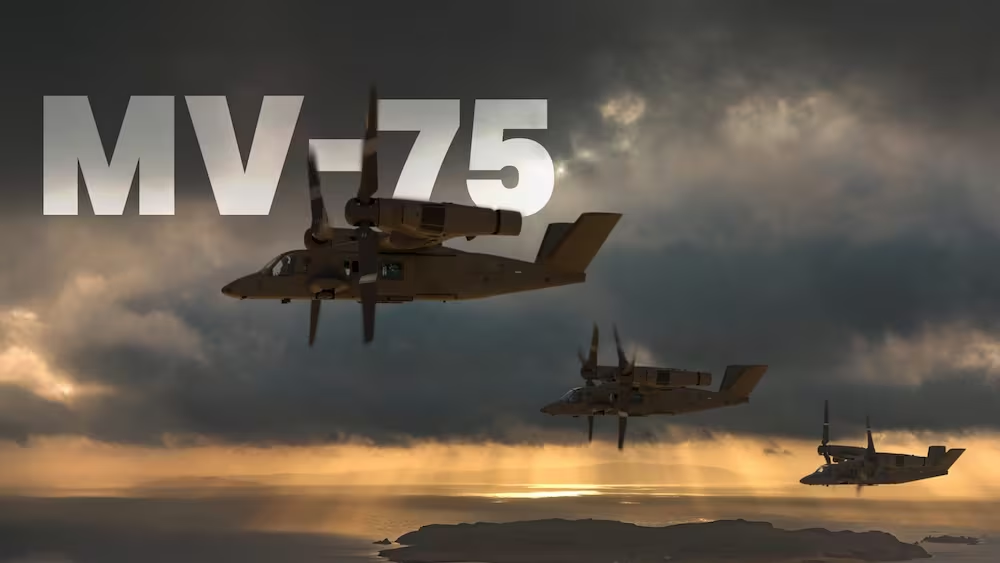
MV-75 FLRAA
Combining the speed and range of the turboprop with advanced agility greater than a traditional helicopter, FLRAA offers better flight performance and lifecycle sustainability. This weapon system was purpose built to revolutionize U.S. Army overmatch in multi-domain operations.
https://www.bellflight.com/products/bell-mv-75
Assessing Synthetic Agent Trust in Humans to Optimize Mission Outcomes in Mosaic Warfare
The research presented here builds on an existing multi-domain robotic teammate framework by exploring the bilateral nature of Human Machine Team (HMT) trust to optimize mission outcomes in a Mosaic-like warfare paradigm. Currently, the scientific community is focusing on measuring human trust with synthetic agent teammates, and the importance of building and sustaining well-calibrated trust to promote HMT interactions necessary for successful mission outcomes. Measuring trust objectively and in real time is a difficult problem, and solving it is essential to support a future warfare requiring rapidly reconfigurable multi-platform HMTs to address the mounting challenges of peer threats. However, the time sensitive nature of these reconfigurable, multi-domain, multi-platform kill webs assumes reliance on synthetic agents, driven by sophisticated Artificial Intelligence (AI), to make split-second decisions on how best to configure and reconfigure these kill webs. Those critical decisions will necessarily need to take into consideration the extent to which a synthetic agent can trust a human operator’s ability to complete mission tasks.

This paper explores and defines HMT relationships across synthetic agents’ personas within our existing multidomain robotic teammate framework to (a) identify human’s psychophysiological constraints across HMTs that can impact the synthetic agent’s trust in humans, and (b) promote the concept of a synthetic Mosaic agent that uses trust to rapidly assign tasks across HMTs to optimize mission outcomes. Theoretical findings are presented within an antisatellite strike and response applied use case to highlight the bilateral nature of trust in HMTs as a key enabler of mission success.
https://www.modsimworld.org/papers/2022/MODSIM_2022_paper_13.pdf
SYNERGISTIC UNMANNED MANNED INTELLIGENT TEAMING (SUMIT) FINAL REPORT
The Manned-Unmanned Teaming (MUM-T) employment concept is a force multiplier for United
States Army Aviation. This collaborative employment of manned and unmanned platforms generates enhanced situation awareness, greater lethality, and improved survivability. The Synergistic Unmanned Manned Intelligent Teaming (SUMIT) program was a 6.3 Science and Technology (S&T) program evaluating the impact of innovative autonomy, decision aiding, and Human Machine Interface (HMI) technologies on an Air Mission Commander (AMC) during the execution of MUM-T scenarios. The primary purpose of SUMIT was to identify Manned-Unmanned Teaming (MUM-T) system capabilities that increase combat effectiveness and provide recommendations on metrics to assess these capabilities.

The U.S. Army Combat Capabilities Development Command (DEVCOM) Aviation & Missile Center (AvMC) recruited 40 volunteer participants with relevant experience to complete challenging MUM-T scenario vignettes in reconfigurable rotary wing flight simulators. Over the course of five system evaluations utilizing integrated vendor proposed design solutions, the results identified MUM-T system capabilities that increase combat effectiveness as well as methodological recommendations for future MUM-T technology assessment efforts.
Aviation, Missile Center simulator supports Army readiness
REDSTONE ARSENAL, Ala. — The U.S. Army Combat Capabilities Development Command Aviation & Missile Center’s Aviation Development Directorate is developing a simulator under the Synergistic Unmanned Manned Intelligent Teaming, or SUMIT, program to enhance situational awareness, provide greater lethality, and improve survivability for the Warfighter.
“The SUMIT program is an early step in a new paradigm for technology development that occurs completely in a synthetic environment from concept exploration to training,” said Dr. Jay Moorthy, CCDC AvMC ADD. “The Warfighter is offered a seamless experience with the ability to shape technologies in early concept stages and to train with the same technologies once matured, all in the same synthetic environment.”
https://www.army.mil/article/222253/aviation_missile_center_simulator_supports_army_readiness
CCDC technology to increase Soldier readiness in multi-domain operations
HUNSTVILLE, Ala. — As the Army continues to develop and implement the Multi-Domain Operations concept, including the seamless integration of land, sea, air, space and cyberspace technology, it chose “Readiness for Multi-Domain Operations” as the theme for this year’s Association of the U.S. Army annual meeting. The event was held March 26-28 at the Von Braun Center in Huntsville, Alabama.
The U.S. Combat Capabilities Development Command, a major subordinate command of the Army Futures Command, displayed the Future Open Rotorcraft Cockpit Environment Simulator, or FORCE, technology in the Army exhibit booth.
Sustainment Virtual Playbook
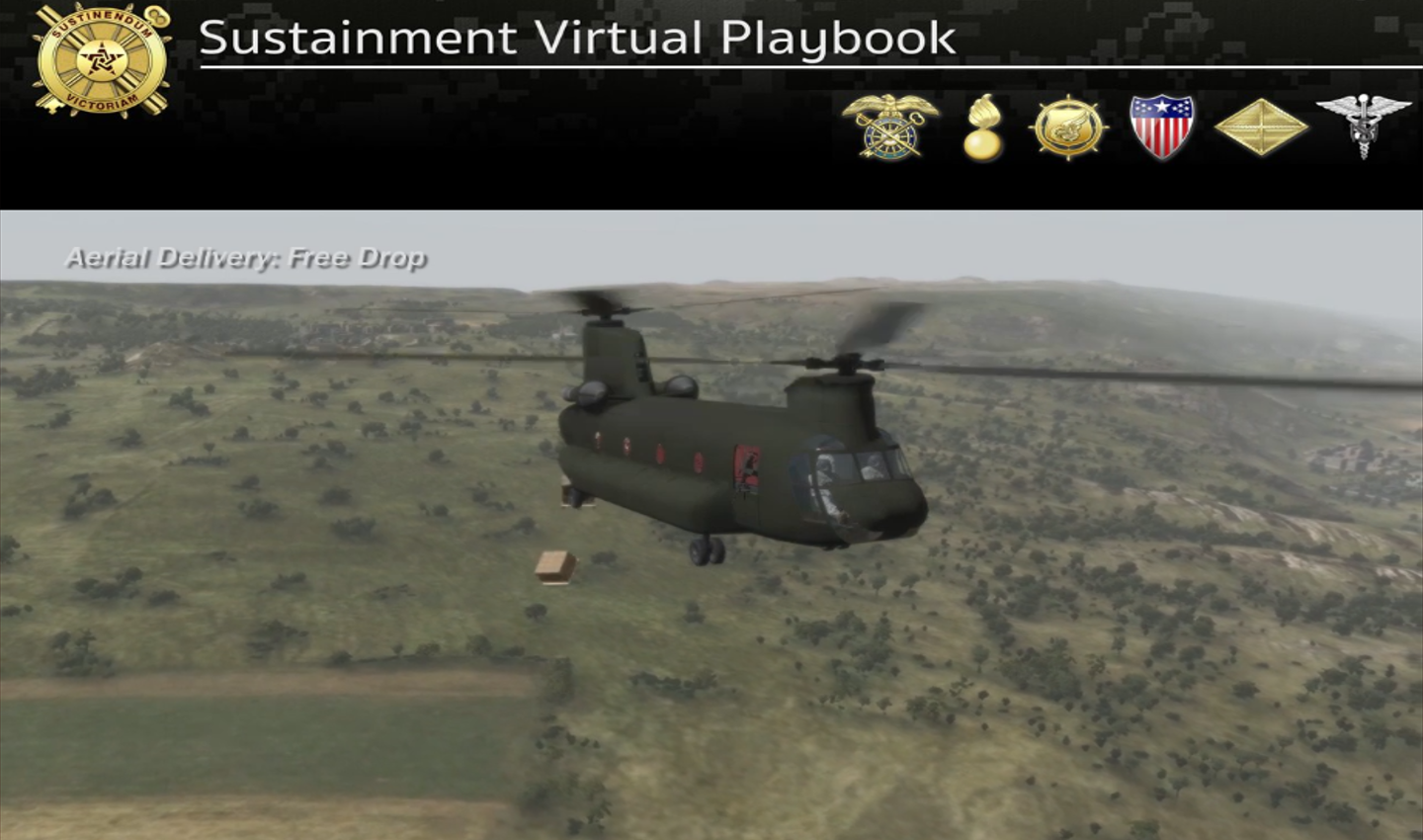
The Army Sustainment Virtual Playbook is an interactive, mobile, eLearning solution to living doctrine. It delivers doctrinal and best practice tactics, techniques, and procedures for executing synchronized sustainment in a decisive action environment. The playbook provides the tools to think through complex sustainment processes that enable freedom of action, extend operational reach, and prolong endurance.
http://www.cascom.army.mil/g_staff/g3/SVPB/SVPB-Chap6/story_html5.html
Virtual OPFOR Academy SUpport
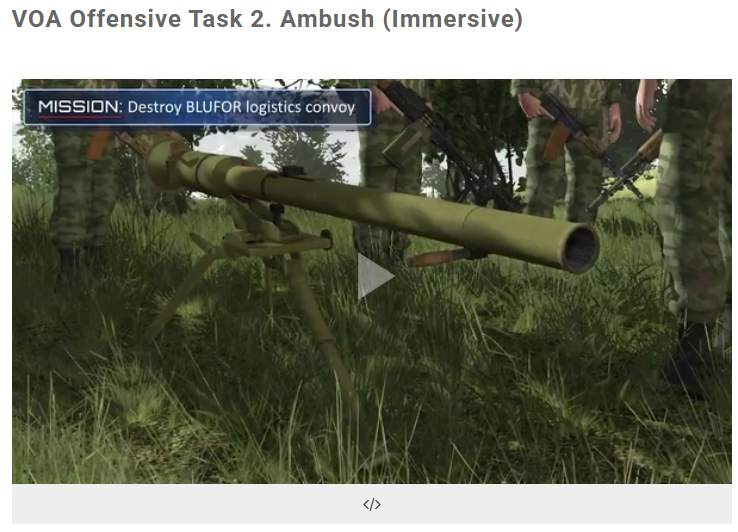
The VOA provides users the information, tools, and resources to learn, apply, and replicate OPFOR counter-tasks to achieve unit training objectives within a collective training environment by exposing users to OPFOR tasks, conditions and standards. The tasks presented on VOA are OPFOR Tasks in support of Combined Arms Training Strategy events.
71-CO-8502 OPFOR Execute an Ambush
Access the immersive content from a government system here:
https://www.dvidshub.net/video/784334/voa-offensive-task-2-ambush-immersive